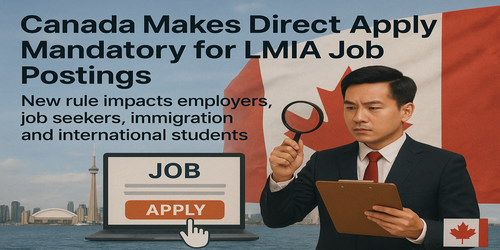
Canada has made some major changes in Temporary Foreign Worker Program (TFWP). Canadian employers hiring for foreign workers through Labour Market Impact Assessment (LMIA) must now enable Direct Apply feature on the Canadian Job Bank.
This new rule is effective immediately and it’s designed to strengthen hiring transparency and ensure Canadian Permanent Residents (PR) and Citizens get priority in applications. LMIA is process which grants work permits to foreign nationals for Canadian jobs.
New Rules for Employers
Canada has implement some new rules on how to apply in these jobs and many more such as:
- Job postings on Job Bank must have Direct Apply enabled.
- Employers must review all applications received through Job Bank.
- At least two other recruitment methods remain mandatory (e.g. company website, LinkedIn and more).
- Non-compliance can lead to LMIA rejection or Job Bank restrictions. This means more scrutiny of LMIA process.
Benefits for Job Seekers
Some of the benefits for this new rule include:
- One-click applications directly through Job Bank.
- No need to create multiple accounts on employer websites.
- Faster access to LMIA-based job opportunities
Impact on Immigration and International Students
This new LMIA rule will be beneficial for Canadian Citizens and PRs plus there will be some other impacts such as:
Canadian Citizens and Permanent Residents Get Priority
Employers now have to prove that they considered a Canadian and permanent resident for the role via the job bank first which will make hiring of foreign work hard.
Temporary Foreign Worker Program (TFWP) Tighter Controls
Canada wants to reduce the reliance on temporary foreign workers to reduce the burden on Canadian housing and ease the high inflation rate.
Some International Graduates May Face More Competition
Well international students doesn’t rely on LMIA’s for their work permits because they get Post Graduation Work Permit (PGWP) under International Mobility Program (IMP) after graduation but some international graduates do utilize LMIA to extend their work permits in Canada.
It’s important to note that if you study for one year then you only get one year of PGWP but if you study for 2 years then you become eligible for 3 years of PGWP. International students utilize this time period to gain valuable Canadian work experience making you eligible in Express Entry streams and PNP streams.
Exemptions
Jobs not affected include, Certain academics (visiting professors, postdoctoral fellows), Camp counsellors, Entertainment roles, In-home caregivers.
Understanding LMIA and the TFWP
A Labour Market Impact Assessment (LMIA) is a document that Canadian employers must obtain from Canadian government before hiring most temporary foreign workers. It proves that no Canadian citizen or permanent resident is available to the advertised job plus the hiring of foreign worker will not negatively impact the Canadian labor market.
The TFWP allows Canadian employers to hire foreign workers to fill temporary labour shortages. It is widely used in industries such as Agriculture, Caregiving, Manufacturing ,Trades , Hospitality and Food services.
E.g. BC widely uses this program for agriculture workers and Atlantic provinces use it for food services workers. We see a big inflow of agriculture workers from Mexico to Canada every season due to this program. This program has its advantages as foreign workers do these jobs which Canadian don’t want to do but on the other hand we see it’s misuse in trucking and food services and retail sector.
Recently we have seen protests from temporary truck drivers protesting against the wage theft and abuse by the employers. Some abusive employers exploit foreign workers via TFWP. Foreign workers are threatened by employers of deportations if they make compliant.