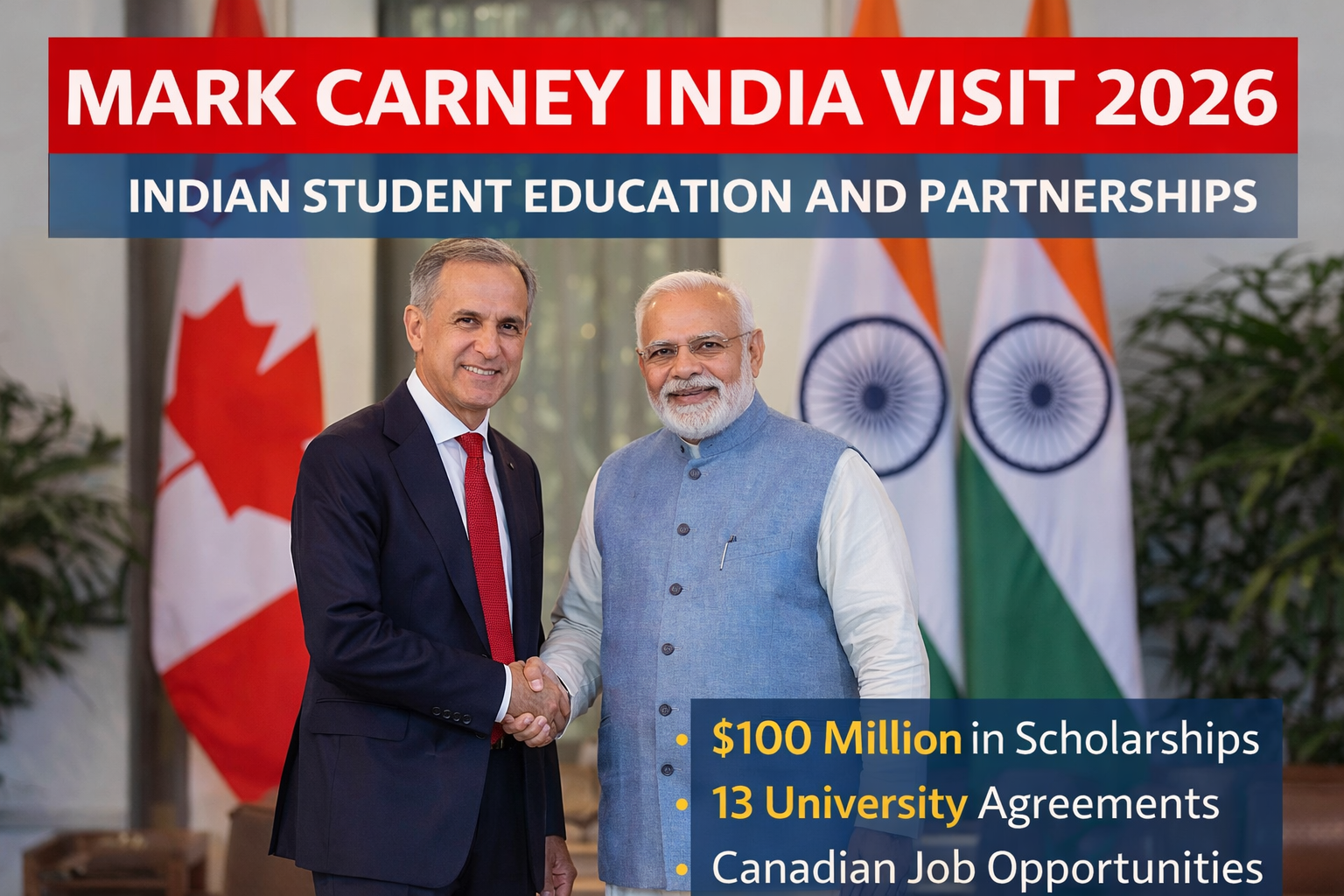
Prime Minister Mark Carney’s India visit has reshaped Canada–India education relations in a way that directly benefits Indian students — especially those planning not just to study in Canada, but to gain Canadian job experience after graduation.
The visit resulted in:
• 13 new university partnerships
• Up to $100 million in scholarship funding
• 300 funded research positions
• Launch of a McGill AI Centre in India
• Expanded student mobility and talent cooperation
But beyond headlines and diplomacy, the real question is that, how does this help Indian students secure Canadian work experience after study?
Let’s talk about it in detail.
🎓 13 University Partnerships: More Than Just Exchange Programs
These 13 new university partnerships, finalized during Prime Minister Mark Carney’s March 2026 visit, mark a departure from traditional “study abroad” models toward a Transnational Education (TNE) framework.
Instead of students simply moving to Canada, these agreements embed Canadian academic standards directly into Indian institutions, creating a seamless “Talent Bridge.”
1. McGill University – AI Centre of Excellence (Bengaluru)
This is the “crown jewel” of the 2026 academic mission. In collaboration with the Jubilant Bhartia Group, McGill is establishing its first physical research presence in India.
- The Model: A “Hybrid Master’s” in Artificial Intelligence. Students complete the first year in India and the second at McGill’s Montreal campus.
- Industry Integration: The curriculum is designed by McGill’s Faculty of Engineering but includes live projects with Indian tech giants to ensure students are “job-ready” for both markets.
- The Goal: To address the global shortage of ethical AI engineers.
2. The O.P. Jindal Global University (JGU) Triad
JGU has signed three distinct MoUs with top-tier Canadian universities (UBC, SFU, and Guelph), focusing on high-level academic mobility.
- UBC + JGU: Focuses on Joint Research in public policy and sustainability. It facilitates a “Dual-Campus” experience where faculty and students swap locations for semester-long intensive research.
- Simon Fraser University (SFU) + JGU: Specializes in Transnational Education. This creates a “Structured Mobility” path where credits earned at JGU are automatically recognized by SFU, allowing for 2+2 or 3+1 degree completions.
3. Dalhousie University + SRM Institute: The Nursing Fast-Track
This partnership is a direct response to Canada’s healthcare labor crisis.
- The “Supernumerary” Seats: 25 seats have been approved by the Indian Nursing Council specifically for this dual-degree program.
- Dual Credentials: Students graduate with degrees from both SRM and Dalhousie.
- Clinical Immersion: The program includes “embedded clinical experience” in Canada. This allows Indian nurses to bypass many of the traditional, years-long “bridging” requirements to practice in provinces like Nova Scotia.
4. University of the Fraser Valley (UFV) + Panjab University
This partnership leverages UFV’s long-standing presence in Chandigarh to create a high-speed business pipeline.
- Direct Entry: Eligible Panjab University students gain direct entry into the 3rd year of UFV’s BBA program in Canada.
- Applied Sciences: Beyond business, the exchange covers applied science, ensuring students gain exposure to Canadian industrial standards before they graduate.
Why these are “Structured Pipelines”
In 2026, a standard Study Permit can be difficult to obtain due to national caps. However, students in these partnership programs benefit from:
- Guaranteed PALs: Most of these programs include pre-allocated Provincial Attestation Letters (PALs).
- Co-op Priority: These universities have matched their curricula so that Indian students arrive in Canada ready to start paid co-op placements in their first semester.
- Pathways to PR: These specific fields—AI, Nursing, and STEM—are the primary categories for 2026 Category-Based Express Entry draws.
💰 $100 Million Scholarship Commitment: Reducing Financial Pressure
One of the most impactful announcements tied to the visit is:
Up to $100 million in scholarship funding
Led by major Canadian institutions, including the University of Toronto.
This includes:
• Fully funded graduate scholarships
• Research assistantships
• Sponsored doctoral programs
• Funded post-graduate positions
Why this matters for job experience:
Students who receive funded research roles often:
Work directly with Canadian professors
Participate in industry-linked research projects
Build Canadian professional references
Enter job markets with local experience
This significantly strengthens post-study employability.
🔬 300 Funded Research Positions: Direct Canadian Experience
Nearly 300 funded research positions are being expanded under collaborative initiatives.
These positions:
• Are located within Canadian universities
• Often involve industry partnerships
• Include stipends and living support
• Provide direct Canadian workplace exposure
For Indian students in:
• AI
• Clean energy
• Advanced manufacturing
• Biotechnology
• Engineering
This means gaining real Canadian work experience even before graduation.
That is powerful for future employment.
🧠 How This Improves Post-Graduation Work Prospects
Indian students often ask:
“Will I get Canadian job experience after study?”
Carney’s visit strengthens that possibility in multiple ways.
1️⃣ Stronger Co-op & Internship Pipelines
University partnerships often include:
• Mandatory co-op programs
• Internship placements
• Industry research collaborations
Students enrolled in these structured programs are more likely to:
✔ Complete Canadian work terms
✔ Build Canadian resumes
✔ Secure job offers before graduation
2️⃣ Better Access to Post-Graduation Work Permit (PGWP)
While visa policies were not directly changed, stronger institutional collaboration means:
• More clarity on program eligibility
• Better institutional support
• Higher credibility of partnered programs
Students graduating from eligible Canadian institutions can apply for the Post-Graduation Work Permit (PGWP).
PGWP allows:
✔ Up to 3 years of open work experience
✔ Ability to work for any employer
✔ Pathway to Canadian PR
3️⃣ Alignment With Canada’s Labour Shortage Sectors
Carney’s visit emphasized cooperation in:
• Artificial Intelligence
• Clean Energy
• Hydrogen Technology
• Advanced Manufacturing
• Innovation & Technology
These sectors align directly with Canada’s immigration and labour market priorities.
Students graduating in these fields are positioned strategically for:
• Skilled work permits
• Provincial Nominee Programs (PNP)
• Express Entry category-based draws
📈 Why Canadian Job Experience Matters So Much
For Indian students, Canadian job experience:
• Increases Express Entry CRS score
• Qualifies for Canadian Experience Class (CEC)
• Improves PNP eligibility
• Makes PR applications stronger
Without Canadian work experience, PR pathways are more competitive.
With it, students often become top candidates.
Carney’s education-talent agreements indirectly strengthen this pipeline.
🌏 Hybrid Study Models: Smart Entry Strategy
Another outcome of the visit is the expansion of hybrid or offshore study models.
This allows students to:
• Start degree in India
• Transfer to Canada later
• Complete final years in Canada
• Enter Canadian labour market
This reduces initial financial burden while preserving long-term mobility.
For middle-class families, this model is highly attractive.
🚀 Career Impact: What This Means Practically
This strategic shift offers a profound structural advantage for Indian students. Normally, the journey is a solitary one: students arrive to study in Canada, only to then compete independently for jobs within an increasingly uncertain pathway to permanent residency.
In the wake of the Carney visit, that trajectory has been replaced by a structured academic partnership model. This new framework integrates built-in research collaborations and direct industry exposure from day one. By securing a funded role early on, students gain critical Canadian work experience while still in school, ultimately resulting in a much stronger PR profile and a predictable route to long-term success.
📊 Canada Remains a Top Destination
Canada continues to host a large Indian students.
Despite temporary visa policy tightening in recent years, this visit signals:
✔ Renewed political support for Indian students
✔ Long-term talent strategy
✔ Institutional expansion
✔ Research and innovation priority
Students are not just temporary residents — they are future workforce contributors.
🎓 Who Benefits the Most?
Students in:
• AI & Computer Science
• Engineering
• Clean Energy
• Biotechnology
• Advanced Manufacturing
• Research-based Master’s & PhD programs
These fields are tied directly to:
✔ Industry collaboration
✔ Co-op work terms
✔ High employability
✔ Immigration pathways
🔥 Why This Visit Is Strategic for Students
This is not just a diplomatic trip.
It signals that Canada:
• Sees India as a long-term education partner
• Wants Indian talent in innovation sectors
• Is investing real money in student mobility
• Is building structured academic-career pipelines
That is long-term positioning.
Final Takeaway for Indian Students
The final takeaway for Indian students is that if your goal is to study in Canada, gain professional experience, and eventually apply for permanent residency, Mark Carney’s 2026 visit has significantly reinforced your roadmap.
By integrating high-level educational partnerships and robust scholarship funding with expanded research and industry collaboration, this new strategy creates a direct pipeline to essential Canadian work experience. In the competitive landscape of 2026, securing this local experience is the single most effective way to build a stronger profile and ensure successful long-term residency prospects.